

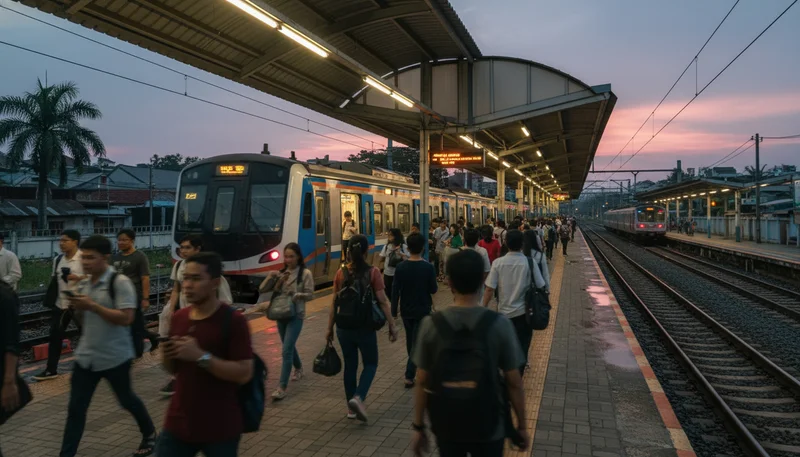
Bekasi Timur Collision Kills 16: KNKT Points to Stalled Taxi, Not Signal Failure
An intercity express struck the rear of a stationary commuter service at Bekasi Timur station in West Java shortly before 21:00 local time on 27 April 2026, killing 16 people and injuring 91. The Argo Bromo Anggrek (KA 4), running from Jakarta Gambir to Surabaya Pasarturi, hit a Cikarang Loop Line Commuterline that had stopped on track 1. All of the dead were in the rear carriage, which was reserved for women.
Indonesia's National Transportation Safety Committee (KNKT) published preliminary findings in late May. They describe a sequence rather than a single failure. A taxi stalled on the track and was struck by the Commuter Line, which then stood on the running line; the signal ahead of the Argo Bromo Anggrek remained green, and the express driver braked around 1.3 km before the point of impact. KNKT also found that the first report of the obstruction reached the southern-region controller while the express was under the eastern-region controller, lengthening the chain of communication before any warning could reach the driver. The committee stressed that these are factual findings, not a final determination of cause.
PT Kereta Api Indonesia operates both services through its Java network, which carries over 300 million passengers annually. The Bekasi corridor is a critical commuter link between Jakarta and its eastern suburbs, with trains running at high frequency during peak hours. Emergency services deployed 15 ambulances and multiple rescue teams to evacuate casualties from the damaged rolling stock, and KAI said it would cover medical costs for the injured and funeral costs for the dead.
The accident is among the deadliest on the Indonesian network in recent years and has pushed two issues up the agenda: the protection of level crossings, after an obstruction on the running line set the sequence in motion, and controller-to-driver communications on a network whose traffic has grown faster than its operating procedures. KNKT's full investigation continues.