

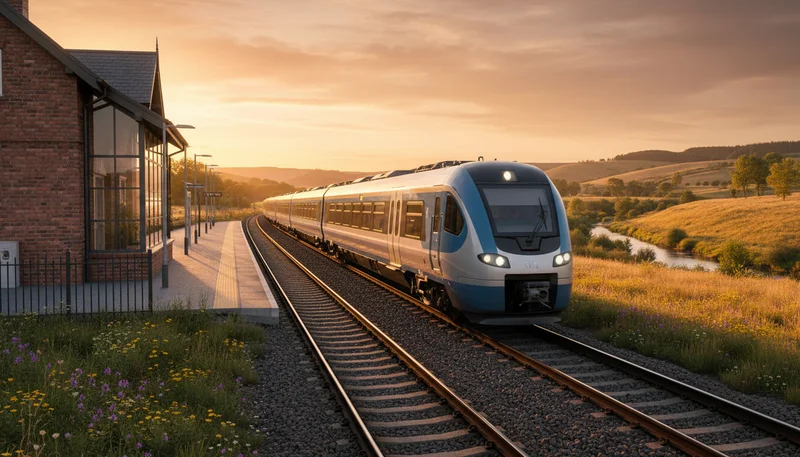
India launches hydrogen fuel cell train on Jind-Sonipat route
Indian Railways inaugurated its first hydrogen fuel cell-powered train on 17 July 2026, deploying the 10-car unit on the 89 km Jind-Sonipat section of Northern Railway, in Haryana. The train, informally referred to in press coverage as "NaMo Green Rail," connects Jind Junction, Gohana Junction and Sonipat, serving intermediate halts including Jind City, Pandu Pindara Junction, Lalit Khera Halt, Bhambhewa, Isapur Kheri Halt, Butane Halt, Khandrai Halt, Rabrah Halt, Lath Halt, Mohana, Barwasni Halt and Sonipat New.
The trainset is powered by a 1200 kW hydrogen fuel cell propulsion system and has a passenger capacity of around 2,600. It has a maximum approved operating speed of 75 km/h, with a design speed of 110 km/h. The 10-car configuration consists of two Hydrogen Driving Power Cars (DPCs), one at each end, and eight Trailer Coaches (TCs). Each DPC houses fuel cells, lithium iron phosphate (LFP) batteries and hydrogen storage cylinders, working together to provide traction power while managing peak loads and regenerative braking.
The train generates electricity onboard using hydrogen, eliminating the need for conventional fossil fuel-based traction. Its primary energy source is a Proton Exchange Membrane Fuel Cell (PEMFC), which produces electricity through a chemical reaction between hydrogen and oxygen across a proton-conducting membrane, releasing only heat and water vapour as by-products. Hydrogen is a high-energy fuel, at 120 MJ/kg compared with 43 MJ/kg for diesel.
The country's largest railway hydrogen storage and refuelling facility has been established at Jind, Haryana, storing nearly 3,000 kg of hydrogen at a time. The Petroleum and Explosives Safety Organisation (PESO) has granted the required licence for the facility, which was designed in accordance with NFPA-2 and ISO 19880 series standards. The entire system underwent an independent third-party safety assessment by TÜV SÜD, Germany. A dedicated maintenance facility at Shakurbasti in Delhi has been prepared to support hydrogen train operations.
Indian Railways developed the train according to specifications issued by the Research, Design & Standards Organisation (RDSO), with system integration carried out by Medha Servo Drives. The deployment on the Jind-Sonipat section is intended to demonstrate the feasibility of hydrogen fuel cell technology for passenger rail operations in India as a pilot project.
Hydrogen fuel cell technology has emerged globally as an alternative to diesel and electric traction systems. The train marks India's entry into hydrogen-powered rail mobility, and the Jind-Sonipat section will serve as the operational testbed for the new traction system. The route is expected to run two round trips a day.