

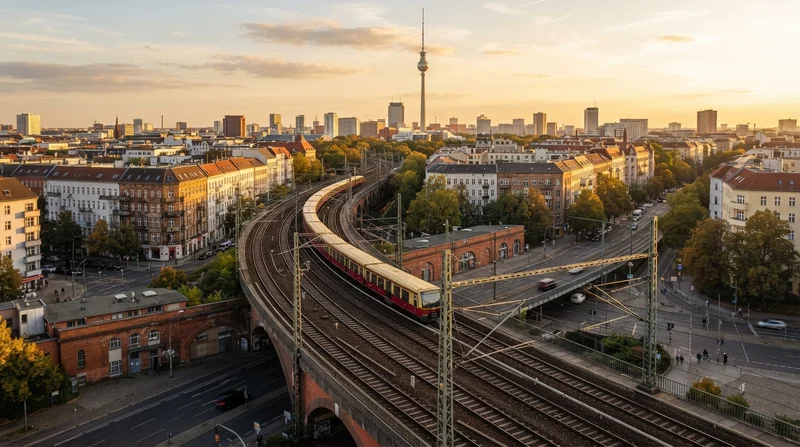
Siemens-Stadler Consortium to Deliver 350 Four-Car S-Bahn Trains to Berlin
A Siemens-Stadler consortium has been awarded a contract to deliver 350 new four-car trains for Germany's Berlin S-Bahn network, one of Europe's largest urban rail systems. The order includes a 30-year maintenance agreement.
The fleet renewal addresses capacity needs across the Berlin metropolitan area. As of September 2023, 106 new trains had been delivered on schedule and entered passenger service, equipped with air conditioning, state-of-the-art passenger information systems and onboard security cameras. Longer formations now operate on Ring lines S41/S42 and the S8 line, increasing overall transport capacity across the network.
The contract moved forward after Alstom withdrew its appeal on June 30, 2026, clearing the path for the Siemens-Stadler partnership to proceed without legal obstacles. The withdrawal removed the final procedural barrier to full-scale production and delivery. The consortium combines Siemens Mobility's traction and control systems expertise with Stadler's rolling-stock manufacturing capabilities, with both companies contributing to the design and production of the new fleet.
Berlin S-Bahn operates a network of 16 lines covering 340 route-km, serving approximately 1.5 million passengers daily. The 350-train order represents a comprehensive modernisation of the fleet, replacing older rolling stock with units designed for higher reliability and passenger comfort. Each four-car formation (a multiple unit consisting of four permanently coupled vehicles) is configured for intensive urban service, with wide doors for rapid boarding and alighting at closely spaced stations.
The phased delivery schedule allows Berlin S-Bahn to integrate new trains progressively while maintaining service levels. The 30-year maintenance component ensures long-term technical support and availability, a standard approach for large urban rail procurements where lifecycle costs and fleet uptime are critical performance metrics. The contract was originally signed in December 2020, with deliveries extending through the mid-2020s.
The new trains feature modern technology throughout, from passenger-facing systems to operational control equipment. Air conditioning provides climate control across all four cars, while digital passenger information systems deliver real-time service updates. Onboard cameras enhance security monitoring, addressing safety requirements for high-frequency urban rail operations. The longer train formations deployed on the Ring lines and S8 route directly increase peak-hour capacity, accommodating growing ridership demand without requiring additional service frequency or infrastructure modifications.