

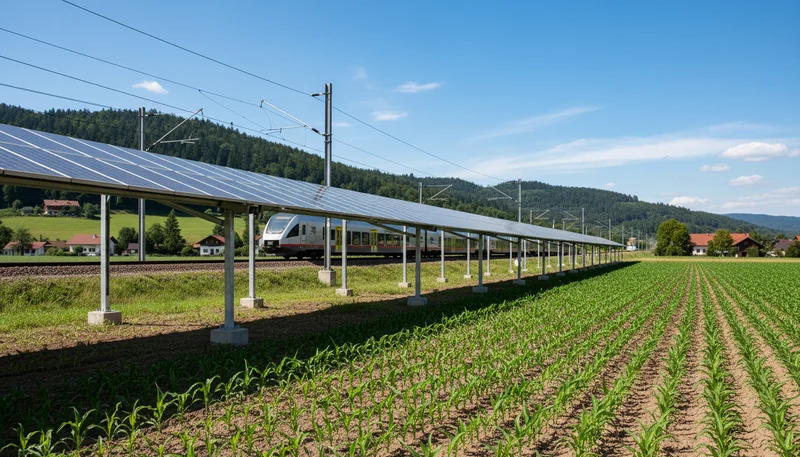
Austria's ÖBB Inaugurates World's First Agrovoltaic Solar Plant for Rail Traction
Austria's Federal Railways (ÖBB) and Burgenland Energie have inaugurated the world's first agrivoltaic plant producing electricity exclusively for rail traction power in Donnerskirchen, Burgenland.
The facility combines solar electricity generation with agricultural use of the land beneath the elevated panels — a dual-use approach known as agrovoltaics. The installation feeds power directly into ÖBB's traction network, making it the first such system globally designed specifically for train operations rather than general grid supply. Organic farming continues on the same parcel, preserving productive land area while adding renewable generation capacity.
Agrovoltaic systems mount solar arrays high enough to allow crops or grazing underneath, addressing land-use conflicts that conventional ground-mounted solar farms create in densely populated or agriculturally productive regions. The plant has an installed capacity of 6.6 MWp and an expected annual output of around 8.3 GWh, fed into the rail power grid via the nearby Pannonia Railway.
Austria's rail electrification already runs on a high renewable share, drawn primarily from hydropower. The Donnerskirchen plant extends that profile with on-site solar generation. Burgenland Energie, the regional utility, is ÖBB's project partner on the plant. The project adds a traction-specific solar source to ÖBB's infrastructure portfolio, distinct from general green power purchase agreements that many European operators use to meet decarbonisation targets.