

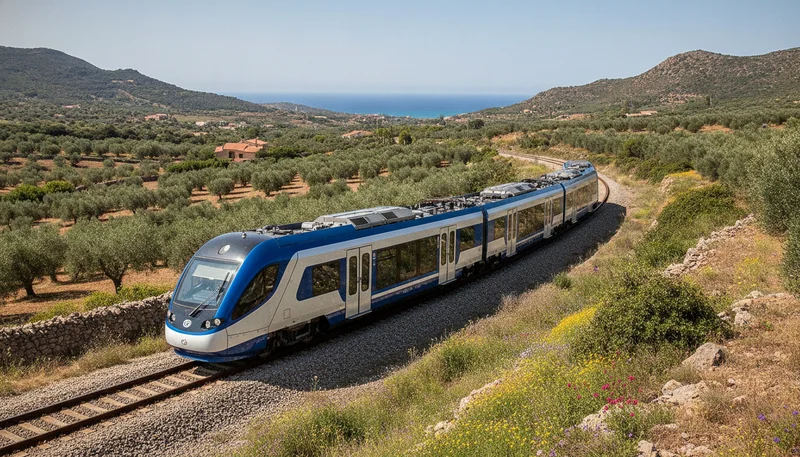
Stadler Unveils World's First Narrow-Gauge Hydrogen Train for Sardinia Network
Switzerland's Stadler and Italy's regional operator ARST have unveiled the world's first hydrogen-powered train designed for narrow-gauge railway lines on June 22, 2026, at a presentation event that introduced the technology as a first in combining narrow-gauge operations with hydrogen fuel cell propulsion.
The development extends hydrogen fuel cell technology to narrow-gauge networks for the first time globally, addressing a segment of the rail industry that has seen limited zero-emission propulsion options. Ten units were ordered under a 2023 framework agreement between Stadler and ARST for deployment on Sardinian regional routes from 2028. The fleet will operate zero-emission services on the island's narrow-gauge infrastructure, which serves regional passenger traffic across the network and has remained dependent on diesel traction.
Stadler designed the trains specifically for narrow-gauge track geometry, integrating hydrogen fuel cells with traction systems compatible with the reduced loading gauge and tighter curve radii typical of such lines. The manufacturer has not disclosed technical specifications including fuel cell capacity, hydrogen storage volume, range between refuelling, or maximum operating speed in materials released at the June 22 unveiling. ARST will introduce the fleet on existing narrow-gauge routes in Sardinia starting in 2028, requiring installation of hydrogen refuelling infrastructure at depot facilities to support daily operations.
The 2023 framework agreement that authorized the ten-unit order established the contractual basis for the delivery schedule extending to 2028. The project adds to Stadler's portfolio of hydrogen propulsion systems, which includes standard-gauge hydrogen multiple units developed for European operators in recent years. Narrow-gauge lines, common in mountainous regions and legacy networks across Europe, have historically relied on diesel traction due to the cost and complexity of electrification on routes with challenging topography.
Hydrogen propulsion offers an alternative for routes where overhead wire installation remains economically unfeasible, particularly on lines with low traffic density or challenging terrain that increases infrastructure costs per route-kilometer. The Sardinian deployment will provide operational data on fuel consumption, maintenance intervals, and infrastructure requirements for hydrogen trains on non-electrified narrow-gauge networks, establishing performance benchmarks for the technology in this application. ARST operates multiple narrow-gauge lines across Sardinia that connect regional communities with limited alternative transport options.