

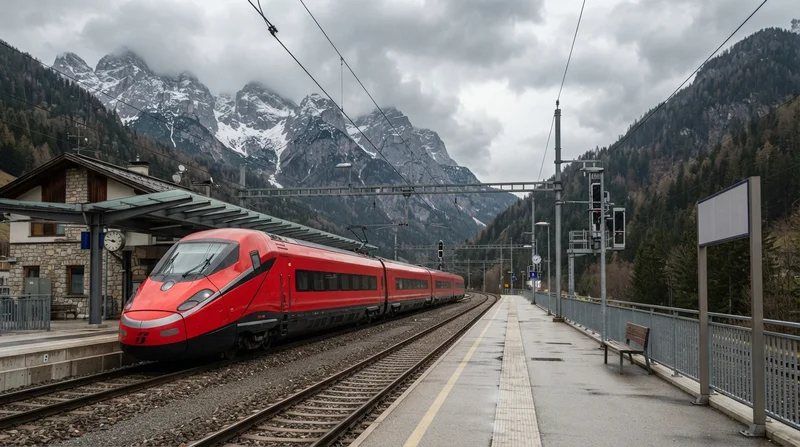
Trenitalia Frecciarossa 1000 Enters Homologation Phase for Italy–Germany Service
Italy's Trenitalia has begun homologation testing of its Frecciarossa 1000 high-speed trainsets for future international services linking Italy and Germany.
The testing phase represents the technical approval process required before the Frecciarossa 1000 fleet — a high-speed electric multiple unit (EMU) capable of operating across multiple European rail networks — can enter revenue service on cross-border routes. The homologation process verifies that the trainsets comply with the safety, signalling and operational standards of the German network, in addition to their existing Italian certification. The Frecciarossa 1000 was designed from inception for multi-country operation, incorporating technical systems compatible with varying electrification voltages and signalling protocols across European networks. The EMU can operate under 3 kV DC, 15 kV AC and 25 kV AC electrification systems, covering the predominant voltage standards on Italian, Austrian and German mainlines.
The testing forms part of a broader plan to establish high-speed rail services between Italy, Austria and Germany. Trenitalia has not disclosed a target date for commercial launch of the Italy–Germany service, nor has it specified which German cities will be served. The route would transit Austria, where Trenitalia already operates international services to Vienna. The Frecciarossa 1000 fleet, built by a Bombardier–AnsaldoBreda joint venture and entering service from 2015, operates at speeds up to 400 km/h on Italian high-speed infrastructure. The trainsets feature distributed traction — with motors located under multiple cars rather than concentrated in power cars — which reduces axle load and improves acceleration performance.
The homologation phase follows Trenitalia's expansion strategy in the liberalised European high-speed market. The operator currently runs Frecciarossa services on domestic Italian routes and international links to France, having launched Paris–Milan services in 2021. The Italy–Germany corridor would mark a further extension of Trenitalia's international network, competing with incumbent operators on German high-speed routes. The Paris–Milan route demonstrated Trenitalia's ability to navigate cross-border regulatory frameworks and compete with SNCF on French infrastructure. No financial details of the homologation programme or service launch investment have been disclosed.
The Italy–Austria–Germany corridor would leverage existing high-speed and upgraded conventional infrastructure through the Alps, including the Brenner Base Tunnel route connecting Italy and Austria. Trenitalia's Vienna services already use this alignment, providing operational experience on the Austrian section that the Germany extension would build upon.